

What you’ll learn
By the end of this guide, you’ll know how to build sophisticated automated workflows that respond to customer behavior in real-time, creating personalized experiences that drive engagement and conversions.Step 1: Access the journeys section
Navigate to Marketing Automation > Journeys in your dashboard. This is your command center for creating automated customer experiences. Click the New journey button to start building your first automation workflow.Step 2: Define your journey foundation
Start by establishing the core parameters that will guide your automation: Name your journey strategically: Use descriptive names like “New Customer Onboarding” or “Cart Abandonment Recovery.” This helps you quickly identify the purpose when managing multiple journeys. Choose your audience wisely:- Specific audience: Select this when you want to target customers with particular characteristics (VIP customers, recent purchasers, etc.)
- All customers: Choose this for universal experiences like welcome sequences or general announcements
Step 3: Build your automation workflow
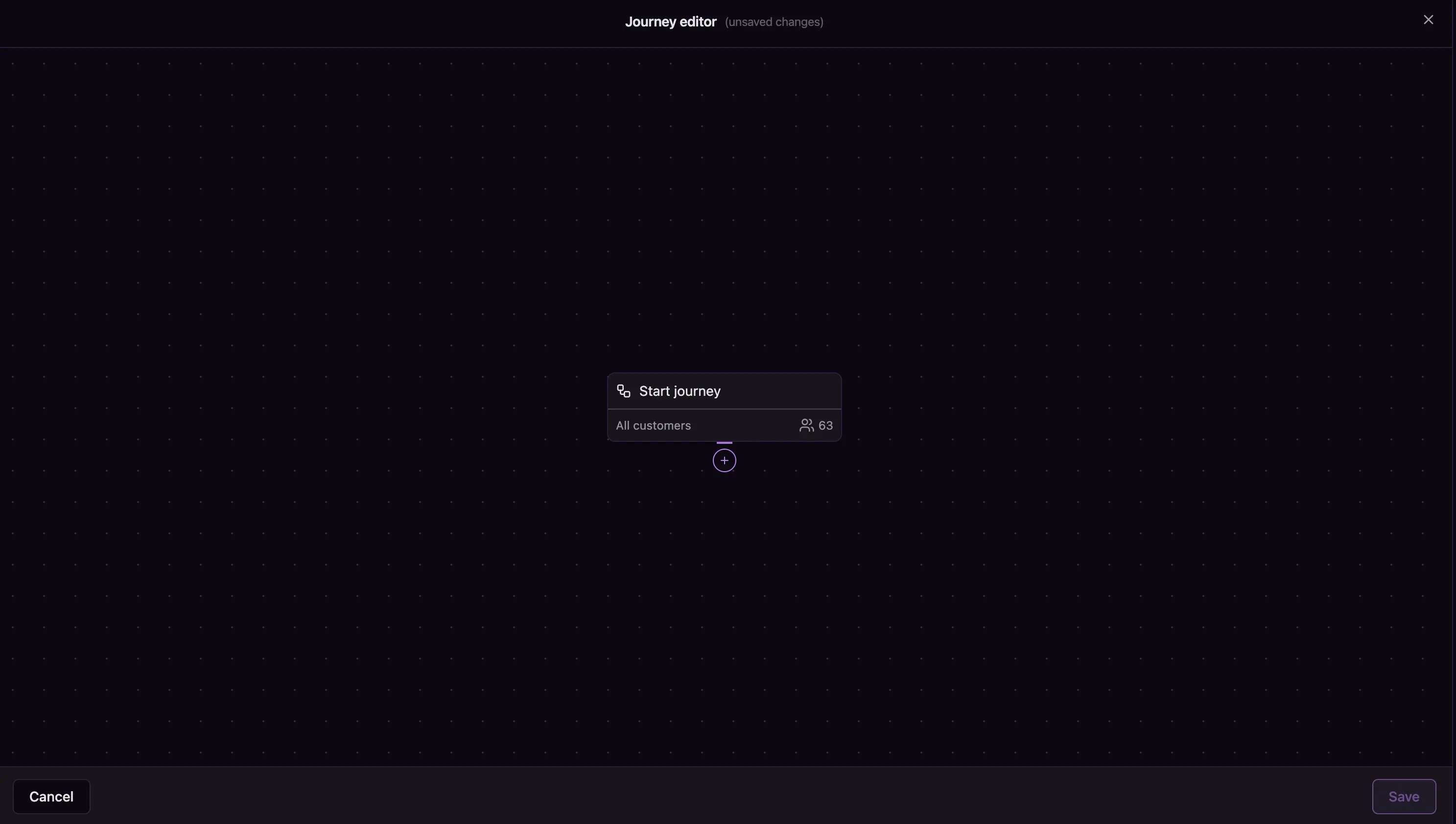
Journey editor
Create your first journey step
Every journey starts with a trigger. Here’s how to set it up: 1. Choose your trigger event: Select what customer action will start this automation 2. Set your conditions: Define who qualifies for this step 3. Configure time delay: Decide when the action should happen (configured in minutes):- Fires immediately: For urgent communications like order confirmations
- Custom wait time: Add strategic delays (e.g., wait 60 minutes)
- Send email: Send a personalized email using your templates
- Send push notification: Deliver a mobile notification. The FCM
datapayload includescustomerIdand does not includenotificationId(unlike dashboard test sends) - Send in-app message: Deliver an in-app message from a template
- Send whatsapp message: Send an approved WhatsApp template
- Send news feed card: Publish a News Feed card from a template
- Loop: Send the customer back to an earlier step
- Send event to destination: Forward an event to a connected destination
- Send to Meta (Customer List Custom Audience): Available when a Meta Audiences destination is connected
- Send to Braze (Client Custom Attribute): Available when a Braze destination is connected
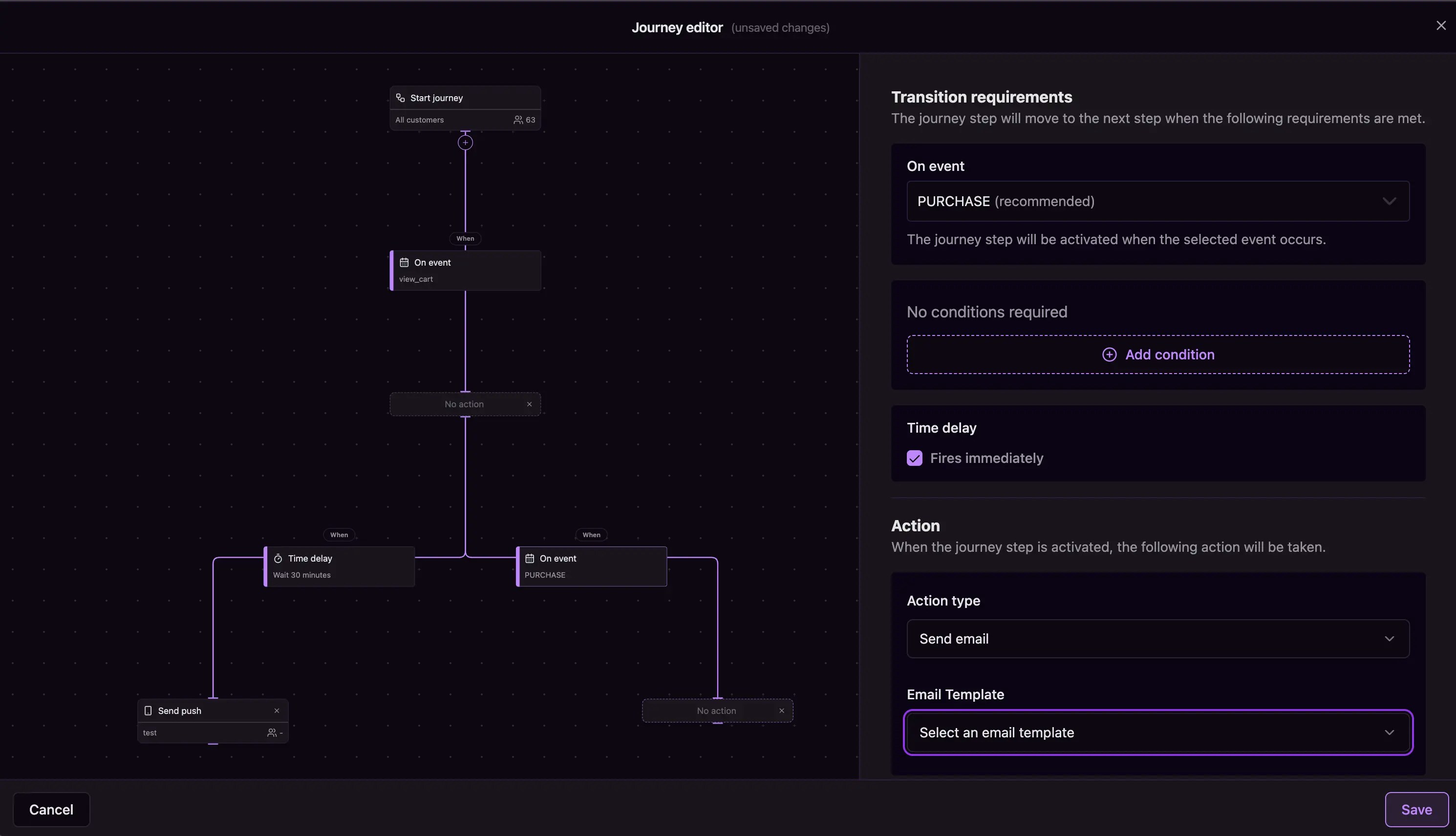
Abandoned cart journey example
Step 4: Connect your templates
Messaging actions use templates you already created:- Email: email template, then an Email variant when the template has more than one version
- Push: push template, then a Push variant when needed
- In-app: in-app template, then an In-app variant when needed
- WhatsApp: an approved WhatsApp template, then a WhatsApp variant when needed
- News feed: news feed card template, then a News feed variant when needed
If you don’t have templates yet, create them first in Email, Push, WhatsApp,
In-app, or News Feed templates. A journey action cannot be saved until the
template (and variant, when required) is selected.
Multiple actions
Each journey step can run more than one action. After the first action exists, use Add action again to attach another. The step header is Actions. The canvas shows the first action in full and+N more when additional actions exist. Click the actions list to open the
panel, then edit or delete any action.
When the customer reaches the step, Masivo runs the actions in the order
you added them. Each messaging action can use a different template and, when
the template has variants, a specific variant.
A step can stay with No actions yet. The customer can still progress when
the step’s trigger and wait time are met.
Template variants in journey actions
If the selected template has more than one template variant, the action form shows Select a variant. You must pick one version before Save is enabled. That action always sends the chosen variant — journeys do not split traffic by percentage on the template. This is separate from split variants, which divide customers into different paths.Split variants (A/B paths)
Use split variants when you want to divide customers into different paths by percentage (for example, Variant A = 70%, Variant B = 30%). This does not change the copy inside a template. To A/B test message content, use template variants.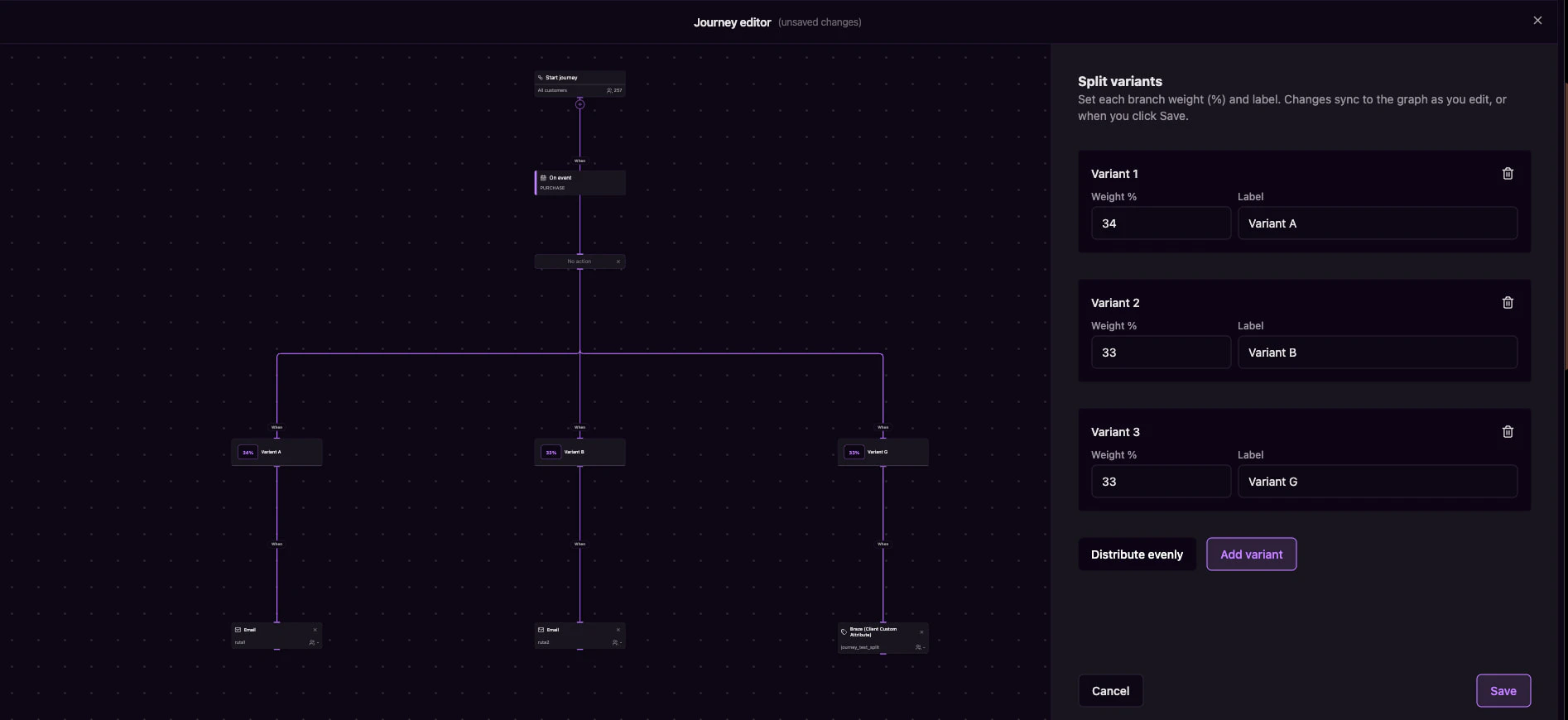
Journey variants
Where you can create a split
- You can create only one split per journey
- The split can be inserted only on first-level steps (direct children of
Start journey) - After a split exists, you can still add regular nodes, but you cannot insert a second split
How to add more variants
After creating the split, click the split node to open the split form and use Add variant.- Do not use the
+menu to create additional variants - Variant branches are managed from the split form
Variant rules
- Minimum weight:
0 - Maximum weight:
100 - Maximum variants per split:
8 - If variants exist, total weight must be exactly
100%
How distribution works
Customers are assigned to one variant using the configured weights.- Example: A = 70%, B = 30%
- If 10,000 customers reach the split, expected distribution is ~7,000 in A and ~3,000 in B
Push payload on journey sends
A journey Send push notification action does not reuse the dashboard test payload. Journeydata includes customerId and accountId; it
omits notificationId. Test sends from the push editor do the opposite.
link is the node short URL when the journey already mapped one. Otherwise
it is the template destination URL. redirect_* keys follow Push
settings when configured.
For test, scheduled audience, and manual API payloads, see FCM data
payload.
What you’ve accomplished
You’ve built an automated customer journey that responds intelligently to
customer behavior, delivering personalized experiences at scale. Your journey
will now work 24/7 to engage customers at the perfect moments.
Related architecture
- Activity & events — How qualifying events enter the loyalty and journey pipeline
- Marketing & destinations — How journeys and messages fit into the marketing data flow